
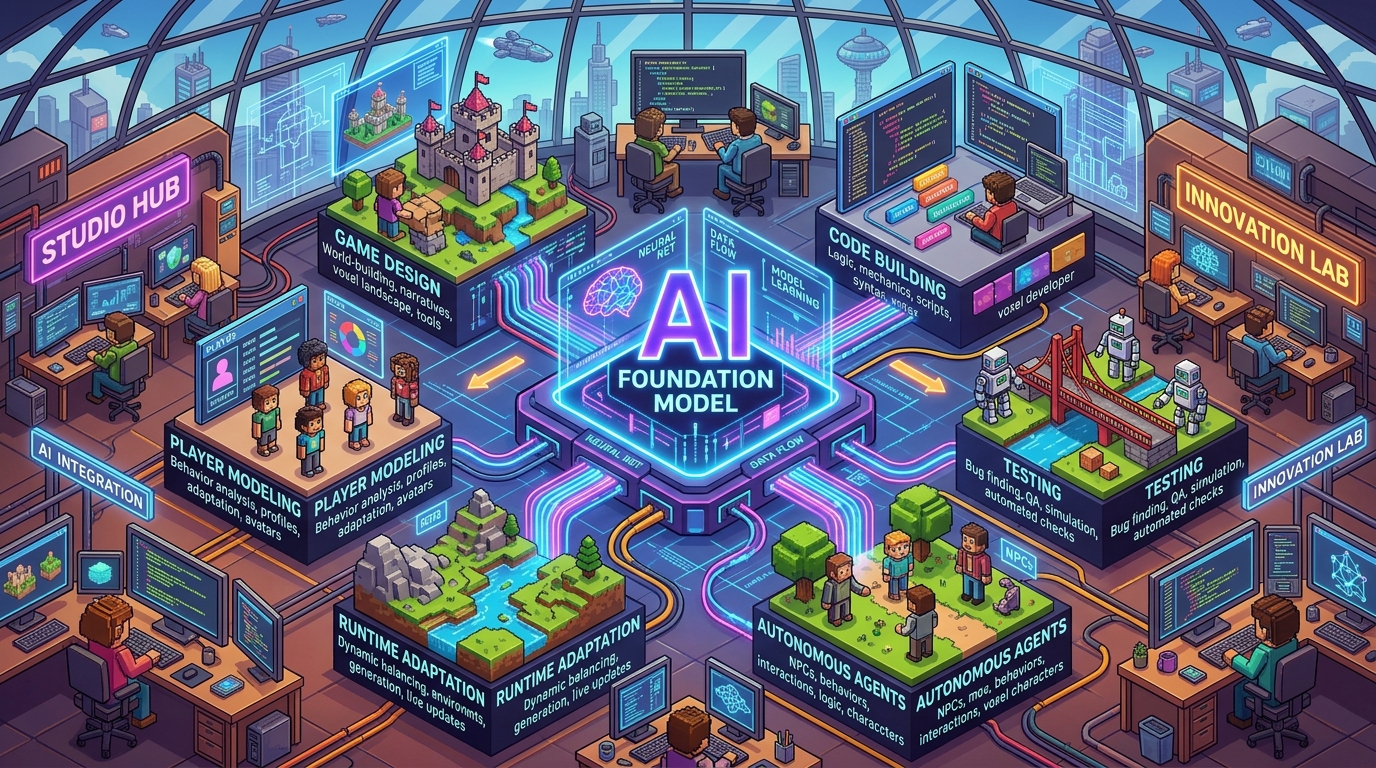
Beyond Mere Chatbots: Foundation Models as Game Infrastructure
In the landmark survey "AI for Games in the Foundation Model Era" authored by researchers at the National University of Singapore (NUS) and Nanyang Technological University (NTU), game AI is redefined not as a simple opponent bot, but as an infrastructure layer spanning the entire creative lifecycle.
Foundation models provide a unified interface connecting natural language, 3D computer vision, procedural code generation, and runtime environmental telemetry.
Deconstructing the Six Foundational Roles
1. Design: Ideating rule structures, level layouts, narrative lore, and mechanics from high-level creator intent.
2. Build & Maintain: Synthesizing shader code, voxel meshes, sound frequencies, and continuous automated documentation.
3. Model: Profiling player skill curves, anticipation vectors, and predicting churn rates to keep players in the flow state.
4. Adapt at Runtime: Dynamically tweaking gravity, spawning jump pads, and adjusting enemy agro based on live performance.
5. Test & Evaluate: Running automated multimodal QA playtesters that discover collision glitches and unreachable platforms.
6. Play & Act: Controlling believable companions and emergent NPC villagers with distinct personalities and memory.
Practical Takeaways for Web Voxel Creators
For independent creators on Gamoji, these six roles mean you no longer need a 20-person specialized studio to release a polished game. By delegating level balance, audio synthesis, and collision QA to foundation model pipelines, a solo creator can publish an arcade masterpiece on their lunch break.